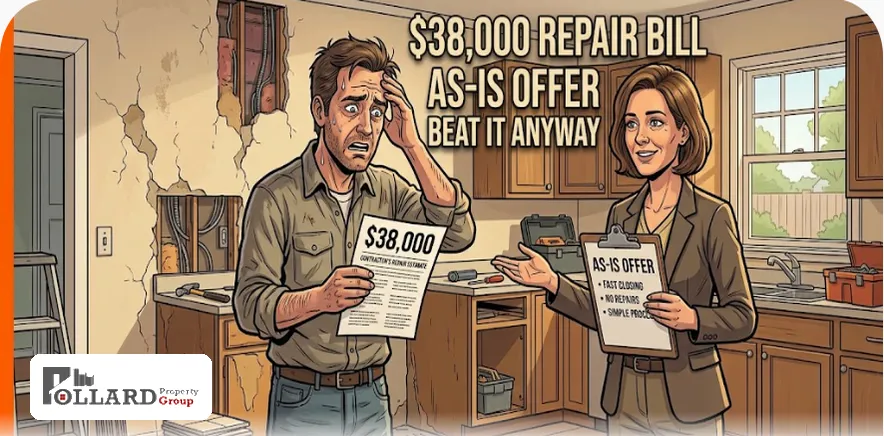
The Repair Bill Said $38,000. The As-Is Offer Beat It Anyway.
A cracked foundation. A roof that was already living on borrowed time. A kitchen straight out of the '90s. A homeowner near La Plata had all three at once, and the contractor's bill to fix everything came to $38,000 -- money she did not have, for work that would take months she also did not have.
Fixing everything first sounds like the smart move. It is not always. Sometimes it is just the more expensive way to end up selling to the exact same kind of buyer anyway.
The real question isn't "which price is higher" -- it's "which one puts more money in your pocket"
Most people assume a fixed-up house always sells for more, so it must be the better deal. Sometimes it is. But the number that actually matters is not the price on the sign -- it is what you actually walk away with after paying for repairs, covering bills while the work drags on, and losing months of time you could have spent already sold and moved on. In Charles County right now, fixer-uppers are sitting on the market a lot longer than move-in-ready homes. That gap between "asking price" and "money in your pocket" is often bigger than people expect.
Trying to decide if repairs are even worth it before you sell? It starts with a conversation. We will run your real numbers together.
1. A repair does not always add back what it costs
Spending $38,000 on repairs does not mean the sale price goes up by $38,000. Some fixes -- like a bad roof or a cracked foundation -- matter a lot, because buyers and lenders will flag them no matter what. Other fixes are just taste. A buyer might have redone that kitchen their own way anyway.
2. Every month of repairs is a month you're still paying to own the house
While repairs are happening, you are still paying the mortgage, insurance, utilities, and property taxes -- with no sale money coming in yet to cover any of it. Around here, repair jobs commonly run three or four months longer than planned. That adds real dollars to the "fix it first" plan that most people never counted.
3. As-is buyers pay less, but they also move faster and don't back out
An as-is sale usually means a lower price. But it also usually means no waiting on repairs, no financing conditions tied to inspection fixes, and a lot less chance the whole deal falls apart halfway through a renovation. That certainty is worth real money, even if it never shows up as its own line on paper.
4. Not every buyer can get a loan for a house that needs a lot of work
Banks are picky about lending on homes with major repair needs. That shrinks the pool of buyers down to cash buyers, investors, and buyers using special renovation loans -- which happens to be exactly who an as-is listing is already built to reach.
5. Run the real numbers both ways before you decide anything
If you only get a repair quote, or you only get an as-is offer, you are working with half the picture. The right decision comes from comparing what you'd actually walk away with on both paths -- not from guessing which one "sounds" smarter.
This same math plays out across Charles County all the time
From La Plata to Waldorf to Bryans Road, homes that need real work are sitting on the market longer than move-in-ready homes in the same zip codes -- including 20601, 20602, and 20646. That is exactly why this math needs to be run with real local numbers, not a national average from the internet.
What one seller actually walked away with
A homeowner near La Plata was staring down a $38,000 repair bill and sold as-is instead. Once carrying costs, financing, and four to six months of project risk were counted against the repair path, her actual take-home landed within about $3,400 of what the fixed-up version would have netted -- without spending the $38,000, taking out a loan, or losing months to construction.
Questions people actually ask
Will I always make less money selling as-is? Not necessarily, once you look at what actually lands in your pocket. The price on paper is usually lower, but after repair costs, carrying costs, and financing are factored in, the real gap is often much smaller than people expect.
How do I know if my house is a good fit for as-is instead of fixing it up first? It depends on what repairs are actually needed, how much time you have, and what it would cost you to pay for the work. Running your real numbers is exactly what we walk through in our first conversation.
Do as-is buyers only want fixer-uppers for investors? No. As-is listings reach a lot of different buyers, including regular homeowners who are comfortable doing some work themselves, not just investors. Who the right buyer is for your specific house is part of what we cover in our first conversation.
It starts with a conversation. We run your real numbers -- repair costs, carrying costs, and what you'd actually take home -- so you can decide with facts instead of a guess. book.waldorfpropertyrescue.com/strategy
