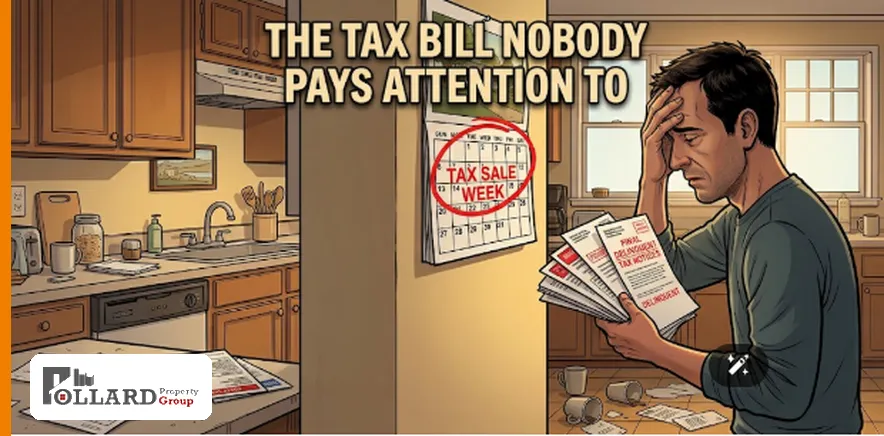
The Tax Bill Nobody Pays Attention To -- Until It Turns Into Someone Else's House
A stranger can legally buy the right to your house over a tax bill smaller than a used car. It sounds made up. It is not. A homeowner near Bryans Road fell behind on her property taxes -- not by a lot, just enough -- and a few months later, an investor she had never met owned a legal claim on her home. She did not lose the house that day. But the clock had already started, and she did not know it.
Here is the part that trips people up: there is no single deadline where the house is suddenly gone. It is scarier than that. The house stays "in danger" for a long time, and every month it stays that way, it gets more expensive to fix.
How a tax bill turns into a real threat to your house
Every year in May, Charles County holds something called a tax sale. If you owe back property taxes by then, your home's tax debt can be sold at auction -- not the house itself, just the debt. An investor buys what is called a "tax certificate." That certificate is basically a receipt that says, "I paid this person's tax bill, and now they owe me, with interest, plus extra fees if it drags on."
You keep living in your house. Nothing changes right away. But now there is a stranger with a legal claim against your home, and a clock quietly running in the background.
Here is the confusing part: Maryland does not give you one clean deadline, like "you have 90 days." Instead, the law says you can pay it back ("redeem" it) any time -- right up until a judge officially closes that door. That sounds like good news. It is not, really. Because the longer you wait, the more it costs, and the investor does not have to wait forever to start the process that ends with you losing the house. Six months after the tax sale (nine months if you actually live in the home), they are allowed to file paperwork in court to try to take that right away from you for good.
Got a tax bill that got away from you? Book a free strategy call and let's figure out exactly where you stand -- no judgment, just facts.
1. It does not take much to end up on the list
You might picture this happening only to people who owe a huge amount. It does not work that way. Even a fairly small unpaid tax bill can land a home on the county's tax sale list. Once it is on there, it is public -- anyone can look it up.
2. "No deadline" does not mean "no rush"
Yes, technically you can pay back the debt at almost any point before a judge shuts the door for good. But "technically allowed" and "cheap and easy" are two different things. Every month that passes, more interest piles on. By law, Maryland charges at least 6% a year in interest once your tax debt is sold -- and some counties are allowed to charge even more. Nothing about waiting saves you money.
3. Paying it back costs more than just the original bill
Here is what most people do not expect: paying the debt off is not as simple as writing a check for the original tax amount. You also owe the interest that has piled up, plus any extra taxes the investor paid on your behalf while they were waiting, plus certain allowed fees. A bill that started at a couple thousand dollars can grow a lot bigger by the time you are ready to deal with it.
4. The real number to remember: 6 months (or 9)
This is the one date that actually matters. Six months after the tax sale -- nine months if you live in the house yourself -- the investor is allowed to file papers in court to permanently take away your right to pay the debt back. That filing does not mean you lose the house that same day. But it is the moment a quiet, private debt turns into a very public, very real legal fight with your name on it.
5. If that court process finishes, you can actually lose the house
If a judge eventually rules that you waited too long, the investor can move toward actually taking ownership of your home -- not just holding a debt against it. That is a much bigger deal than simply owing money, and it is exactly why getting ahead of this early matters so much more than waiting to see what happens.
This happens all over Charles County -- not just to "unlucky" people
Tax sale lists touch homes in White Plains, Bryans Road, La Plata, and Indian Head every single year, in zip codes like 20601, 20602, 20603, and 20646. It is common. It is not a sign someone did something wrong or foolish -- life gets expensive, and taxes sometimes fall behind. If it ever needs to go to court, that happens right at Charles County Circuit Court in La Plata -- a real, local courthouse, not some distant company.
What waiting actually cost one homeowner
A homeowner near White Plains let a tax bill of about $2,400 sit through one full tax sale cycle. By the time she paid it off nine months later, interest and extra fees had pushed the total past $4,100 -- almost double what she originally owed. That is real money that could have covered most of a home sale's closing costs instead.
Questions people actually ask
Can I still sell my house if it has a lien like this on it? Usually, yes. A tax lien is normally paid off out of the sale proceeds at closing, kind of like paying off a mortgage balance. It does not automatically stop a sale from happening.
How long do I really have before I lose the house? There is no single hard date, which is exactly what makes this dangerous. The number to watch is six months after the tax sale (nine if you live there) -- that is when the investor is allowed to start the court process that could eventually take your home.
Does paying back the tax bill make this all go away? Paying the full amount owed -- not just the original tax bill, but the interest and fees too -- is what closes out the investor's claim. Exactly how much that is for your situation, and how to move fast on it, is exactly what we walk through on a coaching call.
On a Free Strategy Call, we walk you through exactly what Maryland requires, in plain English, so you know the real questions to ask and exactly where you stand. If your situation needs a closer legal look, we will tell you what a Maryland real estate attorney should review. That is the call. book.waldorfpropertyrescue.com/strategy
