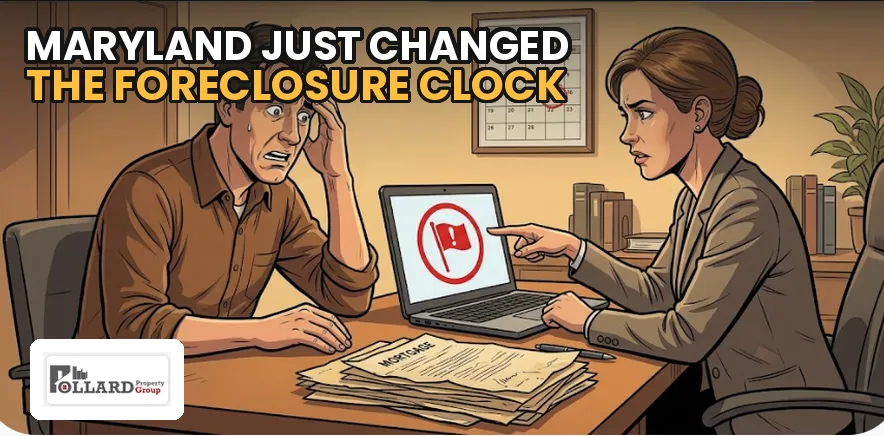
Maryland Just Changed How Long a Lender Can Wait to Foreclose — Here's What It Means If You're Behind
A homeowner outside St. Charles missed a mortgage payment eight years ago. The original lender never foreclosed -- it just sold the debt to another company, which sold it again. No notices, no court filing, just an old default sitting quietly on the title. When the homeowner finally tried to refinance last month, the title company flagged it and the deal stalled.
That is exactly the kind of situation Maryland lawmakers had in mind when they passed a new rule taking effect June 1, 2026: lenders now have an outside deadline for how long they can sit on a default before filing to foreclose. For a homeowner who has been living for years with an old default that never seemed to move, that deadline is one of the first pieces of real, usable information they have had.
Not sure where your own timeline stands, or whether an old default is even still enforceable? Let's map it out together.
book.waldorfpropertyrescue.com/strategy
1. The New Rule, in Plain Terms
Starting June 1, 2026, a Maryland lender has ten years from the date of the alleged default to file the foreclosure paperwork (an order to docket or foreclosure complaint) -- not ten years to finish the case, just ten years to start it. Miss that window, and the lender loses the right to foreclose on that default at all.
Legal fact-check source: Maryland SB 353 (2026 session) — Dept. of Legislative Services fiscal note
2. Why It Matters When the Debt Has Been Sold
For our St. Charles homeowner, the debt changed hands twice -- which is common with older, dormant defaults. The new law added a second protection for exactly this situation: if the debt was already five or more years past due when a new company bought it, that company has to produce paperwork proving the full chain of ownership before it can foreclose. An old default that was quietly resold does not get a clean slate just because a new name shows up on the notice.
Same source as above.
3. Once a Lender Does Act, the Old Rules Still Apply
The ten-year deadline only controls when a lender can start. If our homeowner's lender had moved to foreclose the normal way, Maryland's existing process would still apply on top of it: a Notice of Intent to Foreclose generally goes out 45 days after a default, the lender can file 45 to 90 days after that notice, and once a final loss mitigation affidavit is filed, the homeowner has 25 days and a $50 filing fee to request mediation.
Legal fact-check source: Md. Code, Real Property § 7-105.1; Maryland People's Law Library — Foreclosure Steps and Timeline
4. What This Actually Means for a Homeowner Like Ours
Put the two pieces together and the picture is simple: our homeowner's default happened eight years ago, so whoever currently holds that debt has about two years left to file, and they will have to prove they legitimately own it before they can. That is not a guess -- it is a real, calculable deadline, and it is exactly the kind of number worth having in hand before deciding whether to refinance, sell, or wait it out.
This matters across Charles County -- Waldorf, St. Charles, White Plains, and everywhere in between -- wherever a homeowner is carrying an old default they have not dealt with. The Circuit Court for Charles County handles foreclosure filings for the area, and the mediation process runs through the Office of Administrative Hearings regardless of which court the case is filed in.
The St. Charles homeowner above ultimately chose not to wait out the two years. With the title flagged and a refinance already dead, listing the $320,000 home as-is and letting a sale clear the old default was faster and cheaper than rush title curative work, which commonly runs $1,500 to $3,500 in extra legal and title fees on top of everything else -- money that would have been spent just to get back to square one, not to gain anything.
FAQ
Does this ten-year law erase old debt or stop a foreclosure automatically?
No. It sets an outside filing deadline for lenders going forward -- it does not cancel debt or automatically stop a case that is already filed and moving. What it changes is a lender's window to act on very old defaults.
Does this apply to me if I am already in an active foreclosure?
Generally, this affects when a lender can file in the first place, not the timeline of a case that is already underway. If you are in an active foreclosure right now, the details of your own notice and filing date matter -- that is worth reviewing together.
What if I don't even know how old my default is, or whether my loan has been sold?
That is exactly the St. Charles homeowner's situation above, and it is more common than people think. Pulling the actual servicing and default history is the first step, and it is something we can help sort out before assuming anything about where you stand.
On a Free Strategy Session, we walk through exactly what Maryland's foreclosure timeline looks like for your specific situation, so you know the right questions to ask and where you actually stand. If your case needs an attorney's eyes on the filing or the debt's history, we will tell you which Maryland foreclosure attorney to call. That is the call.
